
How to Import Filter Cartridges from China: 2026 Factory Sourcing Guide | PLEATPURE
Table of Contents
A distributor in Medellín ordered 40,000 hydraulic filter elements from a "factory" he found on Alibaba. The quotation was 38% below the next bid. The first container arrived six weeks late. The second never arrived — the company name on the invoice had changed, and the deposit of USD 18,600 was gone. The elements that did land had a burst strength below the housing relief setting; two filter housings split on commissioning and one line ran unfiltered for hours.
This is not a scare story about China. It is a story about buying from the wrong supplier, and the same failure mode repeats across the filter cartridge trade every year. Importing filter cartridges from China is a mature, workable supply path — Chinese manufacturers supply a large share of the world's replacement filter elements. The failures are almost never about the country. They are about skipping verification steps. This guide covers the decisions that separate a clean import from a costly one: factory versus trading company, total landed cost, writing a spec sheet that produces honest quotes, sample testing, QC, Incoterms, payment protection and the red flags that end deals early. It ends with a step-by-step checklist you can hand to a procurement team.
Key Facts at a Glance
- Definition — Importing filter cartridges from China means buying replacement elements (hydraulic, air compressor, liquid, dust collector, pleated or bag) directly from a Chinese manufacturer or trading company, usually on OEM or cross-brand interchange specifications.
- Factory vs trader — A manufacturer quotes on production cost and owns the tooling; a trading company adds 15–30% margin and can mix sources. For volume and repeat orders, factory-direct wins on price and consistency.
- Landed cost — FOB price is roughly 55–70% of landed cost; freight, duty, customs clearance and agent fees make up the rest. Compare on landed cost, not FOB price.
- Lead time — Standard elements: 2–4 weeks from order to shipment. Custom OEM builds with new tooling: 4–8 weeks plus sample approval.
- Deposit rule — 30% deposit / 70% against copy of B/L is the industry standard. Never pay 50% or more up front to a new supplier without a sample-approved, audit-verified factory.
Why Import Filter Cartridges from China
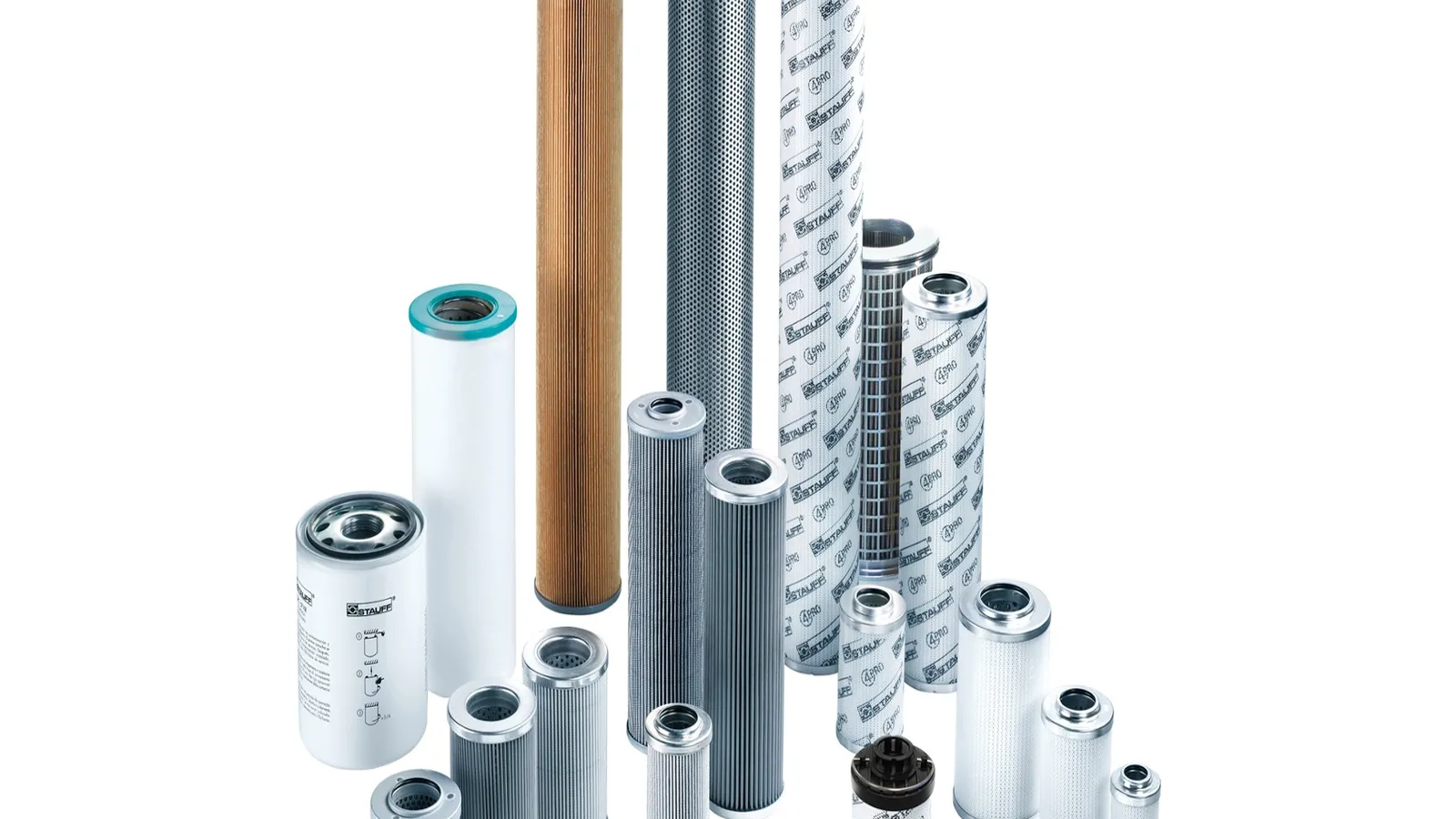
Three numbers explain the trade. First, cost: factory-direct prices for standard hydraulic elements typically run 30–50% below Western OEM prices for the same media class and dimensions. Second, variety: Chinese factories produce interchange elements for Parker, Hydac, Mahle, Pall, Donaldson, Atlas Copco, Ingersoll Rand and dozens of other brands, in glass-fiber, cellulose, pleated polypropylene, melt-blown and stainless mesh media. Third, flexibility: MOQs for standard elements are small (often 10–50 pieces for a trial), and OEM/ODM programs take private labeling from 100–200 units per model.
The trade has limits you should plan around. Shipping from Guangzhou or Ningbo to a South American port takes 25–45 days for sea freight; air freight is faster but multiplies cost. Quality varies between factories by a wide margin — the same "5 micron" rating can mean very different media and efficiency in practice. And after-sales support is only as good as the contract you wrote. None of these are reasons to avoid China. They are reasons to verify before you commit.
Factory or Trading Company: The First Decision
Every Chinese supplier you meet is either a manufacturer or a trading company. The distinction decides your price, your consistency and your recourse.
A manufacturer owns production lines and quotes from cost. It can show you its plant, test equipment and QC records. It controls media sourcing, pleating, end-cap bonding and testing in one place, which is why batch-to-batch consistency is higher. For volume orders, custom OEM work and long-term programs, a factory is the right counterparty.
A trading company buys from multiple factories and resells. It adds margin (typically 15–30%) and can be useful for consolidating several product types from different factories into one container. The risk: it does not control quality, lead time or production capacity, and if a batch fails you are negotiating through a middleman. Trading companies also sometimes present themselves as factories — the single most common deception in the filter trade.
How to verify in 15 minutes: ask for a live video walkthrough of the production floor showing the specific machine that makes your product (pleating machine, melt-blown line, bonding station), ask for the factory's business license (营业执照) with the name matching the invoice issuer, and cross-check the address on the license against the production video. A trading company cannot show you a pleating line it does not own. This one check eliminates most bad deals.
Total Landed Cost Breakdown
Compare suppliers on landed cost per unit, not FOB price per unit. For a 20-ft container of standard hydraulic elements, a realistic breakdown looks like this:
| Cost component | Typical share of landed cost | Notes |
|---|---|---|
| FOB price (goods) | 55–70% | The factory quote; varies by media class and volume |
| Ocean freight | 8–15% | 20-ft container, China to South America: roughly USD 2,500–6,000 depending on route and season |
| Import duty | 5–15% | HS code 8421.29 in most markets; verify local classification, some filter media classes differ |
| Customs clearance + agent fees | 2–5% | Broker, handling, terminal charges |
| Inspection (optional but recommended) | 0.5–2% | Third-party pre-shipment inspection, typically USD 300–600 per container |
| Bank/transfer fees | 0.5–1% | T/T fees and FX spread |
Duty rates deserve a specific check for your market: filter cartridges usually fall under HS 8421.29 (filtering machinery parts), but some countries classify replacement elements differently, and free-trade agreements can cut the rate to zero. Get the classification confirmed by your customs broker before you quote a landed price to your customers.
A quick rule of thumb: multiply FOB price by 1.3–1.6 to estimate landed cost. If a supplier's FOB price is 38% below the next bid, the gap is usually not efficiency — it is media quality, testing shortcuts or a trading company quoting a product it has never made. Price outliers deserve extra verification, not extra enthusiasm.
Writing a Specification That Gets Honest Quotes
Vague RFQs produce vague quotes. "Hydraulic filter element for Parker" tells a factory nothing useful — Parker alone has thousands of part numbers across dozens of series. A spec sheet that gets honest, comparable quotes has eight fields:
- OEM part number and series — e.g. "Parker 939320Q, series 9300". This is the fastest way to a correct cross-reference.
- Dimensions — outer diameter, inner diameter, length, end-cap style (DOE, 222 O-ring, 226 O-ring, thread, flange). Millimetres.
- Media class — glass-fiber (typical for hydraulic pressure filters), cellulose, pleated polypropylene, melt-blown, stainless mesh.
- Micron rating and efficiency — e.g. "10 µm, β10≥200 (ISO 16889)". Beta ratio is the honest number; "10 micron" alone is not.
- Operating conditions — fluid type, max pressure, max temperature, flow rate.
- Burst/collapse pressure — the minimum the element must survive without collapsing.
- Certifications required — ISO 9001 factory certificate, test reports per lot, FDA/REACH/RoHS where relevant.
- Quantity, packaging and target price — annual volume, per-container quantity, and your target range. A stated target price range attracts serious quotes and filters out random bids.
Send the same spec sheet to three or four suppliers and compare like for like. If one supplier asks for a sample or drawings to confirm the cross-reference, that is a good sign — it means they check fit, not just price. If a supplier quotes instantly with no questions, treat the quote as a placeholder until they can show the matching dimensions.
Sample Verification: What to Test
Never skip samples on a new supplier, regardless of the price. Order 2–5 samples of each part number, and test four things before you approve production:
- Dimensional fit — OD, ID, length and end-cap seal against the actual housing or a known-good OEM element. A 0.5 mm error in seal diameter means bypass.
- Construction quality — end-cap bonding (no loose seams), pleat count and consistency, core strength, gasket material.
- Functional test — pressure drop across the element at rated flow, and burst/collapse pressure if your application is demanding. A simple bench test with a pressure gauge catches most weak builds.
- Media inspection — for hydraulic elements, ask for the ISO 16889 multi-pass test report if the application is critical; for liquid/water, verify the micron rating with a bubble-point or challenge test where applicable.
Keep one approved sample sealed and labelled as the reference. Production batches must be compared against it — a factory that matches the sample on the first order usually matches on the fifth. A factory that cannot reproduce its own sample is a one-order supplier.
In-Process QC and Pre-Shipment Inspection
Samples are not a guarantee of production quality. The gap between sample and container is where most import problems live. Two layers of protection:
Contract-level QC: put testing into the purchase order. Standard language: "Each lot shall be 100% dimensionally checked on OD/ID/length; 5% of each lot pressure-drop tested; test reports supplied with each shipment." A factory that already does this will accept the clause. A factory that fights it is telling you its QC does not exist.
Third-party pre-shipment inspection (PSI): for orders above roughly USD 5,000, use a third-party inspection company (SGS, Bureau Veritas, TÜV, or a local agent you trust). A typical PSI checks quantity, dimensions on a random sample (AQL level II), packaging, label correctness and basic function, and costs USD 300–600 per container. It converts "trust me" into a report you can hold. For critical elements — hydraulic pressure-line filters, safety-relevant dust collector cartridges — PSI is not optional, it is the price of the contract.
Shipping, Incoterms and Documentation
Choose your Incoterm explicitly and understand where risk transfers. For first-time importers, FOB (free on board) is the common starting point: the seller delivers to the named port and loads, you own the goods and the risk from that point, and you book the freight. CFR/CIF adds freight (and insurance for CIF) to the seller's side but keeps the risk transfer at the port. EXW (ex works) puts everything — trucking, export clearance, freight — on you; only use it if you have a trusted freight forwarder at the factory's location.
Documents you will need, and should specify in the contract: commercial invoice (invoice amount must match the declared value used for customs), packing list, bill of lading (sea) or air waybill (air), certificate of origin (some markets need it for preferential duty), and the factory's export license details. If your market requires it, add a test report or certificate of conformance per shipment.
Lead time planning: standard elements 2–4 weeks from confirmed order to shipment; custom OEM builds 4–8 weeks plus sample approval round. Add 25–45 days ocean freight, 2–7 days customs clearance at destination, and 1–2 weeks of buffer before you quote a delivery date to your own customers. First orders always take longer than the plan.
Payment Terms and Protecting Your Deposit
The standard terms in the filter trade are 30% T/T deposit, 70% against copy of B/L (bill of lading). The deposit funds raw media and tooling; the balance releases when the goods are actually on the vessel. This structure protects both sides: the factory does not ship unpaid, and you do not pay in full before goods exist.
For new suppliers, tighten the sequence: 30% deposit, then sample approval, then 70% against copy of B/L. For large or first orders, a letter of credit (L/C at sight) moves the payment risk to the banks — slower and more expensive, but it eliminates the "changed company name" failure mode from the opening story. Never send more than 50% up front to a supplier you have not audited, and never send the balance before the B/L number is real (verify it with the shipping line if the amount is significant).
Red Flags That Kill Sourcing Deals
- Price 30%+ below every other quote — on identical specs, this is media or testing being cut, not efficiency.
- Company name changes between quotation, invoice and bank account — a classic trader-switch or exit-scam signal.
- No production video or refuses a live walkthrough — if there is no floor, there is no factory.
- Instant quotes with no questions — nobody serious cross-references a Parker part number in 30 seconds.
- Deposit-only terms ("we do not accept balance against B/L") — non-standard for this trade; ask why.
- No test reports, or reports that never arrive — QC documentation is the product; without it you are buying cardboard.
- MOQ far below the market (e.g. 5 pieces for a custom OEM build) — below-cost MOQs usually mean the "factory" will drop-ship from someone else, adding a middleman you never met.
Step-by-Step Import Checklist
- Write the 8-field spec sheet (part number, dimensions, media, micron + beta ratio, operating conditions, burst pressure, certifications, quantity and target price).
- Shortlist 3–4 suppliers from directories and referrals; run the 15-minute factory verification (video walkthrough + business license + address match).
- Request quotes on identical specs; compare on estimated landed cost (FOB × 1.3–1.6), not FOB price.
- Order 2–5 samples per part number; test dimensions, construction, pressure drop and media against a known-good element.
- Approve samples, seal one as the reference, and put QC clauses (100% dimensional check, 5% pressure-drop test, reports per lot) into the PO.
- Agree Incoterms (FOB for most buyers), documents list and lead time in writing; confirm HS code and duty with your broker.
- Pay 30% deposit; book third-party PSI for orders over USD 5,000.
- Pay 70% against copy of B/L; verify the B/L with the shipping line for large amounts.
- Track the shipment, clear customs, and inspect the container against the PSI report on arrival.
- Run the second order to validate consistency — the second container is where real supplier quality shows.
The Bottom Line
Importing filter cartridges from China is a proven supply path with real cost advantages — provided you verify the factory, write an honest spec, test samples, put QC in the contract and protect your payment. The buyers who get burned skip steps; the buyers who build repeatable programs treat verification as part of the product. Every step in this guide is a step a serious factory like PLEATPURE is happy to walk through with you, because verification is exactly what separates a serious factory from a name on an invoice.
NEXT STEP
Ready to Switch to Replacement Filter Cartridges?
Send us your element dimensions or part numbers — our team responds within 24 hours with pricing and lead time.
Written by
Ray ChanFiltration Buyer's Guide Author · Industrial Filter Cartridge Specialist. Ray helps global importers, distributors and maintenance teams source factory-direct replacement filter cartridges.