
Filter Cartridge End Caps: Selection Guide (222 O-Ring, 226, DOE, SOE) | PLEATPURE
Table of Contents
A maintenance buyer in Bogotá ordered 100 replacement cartridges for a 10-inch housing, specifying "standard double open end" — the way every previous order had been written. The new cartridges leaked at the seal on installation. The housing, it turned out, used a 222 O-ring configuration with a bayonet-style spring, not a plain DOE. All 100 cartridges were the wrong end cap. The correct ones cost 12% more, the wrong ones sat in a crate, and the line ran on old cartridges for two weeks waiting for the right seal.
On a filter cartridge, the end cap is the compatibility spec. The media removes the particles; the end cap decides whether the cartridge seals in the housing or leaks bypass. Get the micron and the media right and the end cap wrong, and the cartridge is scrap before it runs. This guide covers the base types (DOE, SOE), the O-ring styles (222, 226), the variants (fins, spears, bayonet), how to match an end cap to a housing, and the mistakes that cost buyers money. It is written for anyone who sources replacement cartridges from a spec sheet instead of a part number.
Key Facts at a Glance
- Two base types — DOE (double open end) with no fitting, sealed by a housing rod; SOE (single open end) with one closed cap, sealed by a fixed or spring-loaded cup.
- Two O-ring standards — 222 and 226 refer to the O-ring inside diameter in millimetres (about 62 mm and 69 mm respectively); 226 adds a bayonet flange for locking in a spring cup.
- Common sizes — 222 and 226 are the standard for 10", 20", 30" and 40" cartridges; 226 is the default for higher flow and higher pressure, 222 for standard duty.
- Match rule — Never order by "standard"; order by the exact style the housing seal calls for, read off the housing spec or the old cartridge's end cap.
- Bypass cost — A mismatched end cap leaks untreated fluid past the cartridge, contaminating downstream and voiding the filtration's purpose — the most expensive silent failure in cartridge systems.
Why the End Cap Decides Compatibility
The end cap is the interface between the cartridge and the housing. It has one job: force all the fluid through the media, with none leaking around it. The housing is designed around a specific end cap style, and the seal geometry — O-ring, gasket, or compression — is what makes that happen. When the cartridge's end cap matches the housing, the seal is positive and the full flow goes through the media. When it does not, the cartridge either does not fit at all, or fits badly and bypasses.
This is why the end cap, not the micron rating, is the first line of a cartridge spec. Two cartridges with identical media and rating but different end caps are not interchangeable. Every buyer who has ever ordered "the same as last time" and got a crate of wrong seals knows this — the specification must name the end cap explicitly.
DOE and SOE: The Two Base Types
DOE (double open end). The cartridge is open at both ends and has no fittings. It slides over a centre rod or tie rod in the housing; the housing's end plates compress the cartridge ends with gaskets or O-rings to seal. DOE is simple, cheap and common in smaller, lower-pressure housings, especially where cartridges stack on a single rod.
SOE (single open end). The cartridge has one open end (the connection) and one closed end (a cap). The open end seals into a fixed or spring-loaded cup in the housing, and the closed end sits free or is guided at the top. SOE is the standard for higher flow and higher pressure, where a positive seal at one end is more reliable than compression at both.
The choice is the housing's, not the buyer's: a housing built for DOE rod-stacking cannot accept SOE cartridges, and vice versa. Reading which type a housing uses is the first step in any replacement order.
222 and 226 O-Ring Styles
Within SOE, the O-ring style dominates modern cartridge filtration. The numbers 222 and 226 refer to the O-ring's inside diameter — approximately 62 mm for 222 and 69 mm for 226 — and they are the two most common standards worldwide (originally associated with 20-inch cartridge conventions, now used across lengths).
- 222 O-ring — the workhorse for standard duty: water, general filtration, moderate flow and pressure. Seals into a fixed cup with a single O-ring on the cartridge's open end.
- 226 O-ring with bayonet — adds a locking flange (bayonet or fin) that engages a spring-loaded cup. The spring holds the cartridge in place and the O-ring seals. 226 is the standard for higher flow, higher pressure, food and pharma duty, where a positive, vibration-proof seal matters.
The practical rule: if the housing is a standard cartridge housing and you are unsure, the spec sheet says. If the old cartridge has a 226-style bayonet flange, order 226; if it is a plain O-ring without a flange, order 222. Never convert one to the other without changing the housing cup.
Fins, Spears and Other Configurations
Beyond the two base types and the two O-ring standards, manufacturers add variants to fit specific housings or improve sealing:
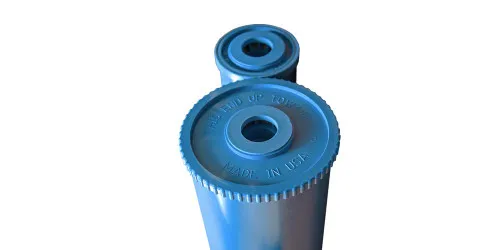
- Fins / bayonet — the locking flange on a 226 cartridge that engages the cup's spring. Some housings use a different fin count or pitch; always match the fin geometry to the cup.
- Spear / dowel — a centre extension used on some DOE configurations to align and seal the cartridge on the rod.
- Flat gasket and cap styles — some SOE housings seal with a flat gasket on the cap rather than an O-ring groove; the gasket diameter matters.
- Molded-on versus glued caps — a manufacturing difference that matters for chemical compatibility and pressure rating; food and pharma grades use thermally bonded, contaminant-free caps.
The takeaway: the spec is not "DOE or SOE" — it is the complete seal geometry, including O-ring size, flange, gasket and length. A photo or drawing of the old cartridge's end cap removes all ambiguity.
How to Match an End Cap to a Housing
- Read the housing spec — the nameplate or datasheet states the cartridge connection: 222, 226, DOE, or a brand-specific style.
- Inspect the old cartridge — measure the O-ring inside diameter (222 ≈ 62 mm, 226 ≈ 69 mm) and check for a bayonet flange. A photo is worth a thousand spec sheets.
- Match the length and micron — once the end cap is confirmed, length (10", 20", 30", 40") and micron rating complete the order.
- Check the O-ring material — Buna-N (EPDM for food/water), Viton for chemicals — the O-ring must survive the fluid, not just fit.
- Ask for the interchange code — if the housing or cartridge carries a brand number (e.g. a Parker, Hydac or 3M-style code), the cross-reference confirms the end cap before you order.
PLEATPURE cross-references cartridges to the original brand numbers, so the end cap style is verified against the manufacturer's spec — not guessed from a description.
Common Buying Mistakes
- Ordering "standard" without a spec — there is no universal standard; the housing decides. Name the end cap or the brand number.
- Assuming 222 and 226 are interchangeable — they are not; 226's bayonet needs the spring cup, 222 does not have it.
- Ignoring the O-ring material — a correct-size O-ring in the wrong elastomer swells, hardens or dissolves in aggressive fluids.
- Buying on micron alone — the finest media in the wrong end cap is bypass scrap; compatibility first, performance second.
- Not keeping a sample — keep one old cartridge or a photo set of the end cap; it makes every future order foolproof.
The Bottom Line
The end cap is the compatibility spec: DOE or SOE as the base, 222 or 226 as the O-ring standard, and the flange, gasket and O-ring material as the fine print. Match it to the housing — from the spec sheet, the old cartridge, or a cross-reference code — and the cartridge seals, filters and lasts. Mismatch it and the bypass defeats the filtration entirely. Send us a photo of your old cartridge or the housing part number — we will confirm the end cap and quote the right cartridge, not a guess.
NEXT STEP
Ready to Switch to Replacement Filter Cartridges?
Send us your element dimensions or part numbers — our team responds within 24 hours with pricing and lead time.
Written by
Ray ChanFiltration Buyer's Guide Author · Industrial Filter Cartridge Specialist. Ray helps global importers, distributors and maintenance teams source factory-direct replacement filter cartridges.