
Cartridge Filter vs Sand Filter: Complete Comparison 2026 | PLEATPURE
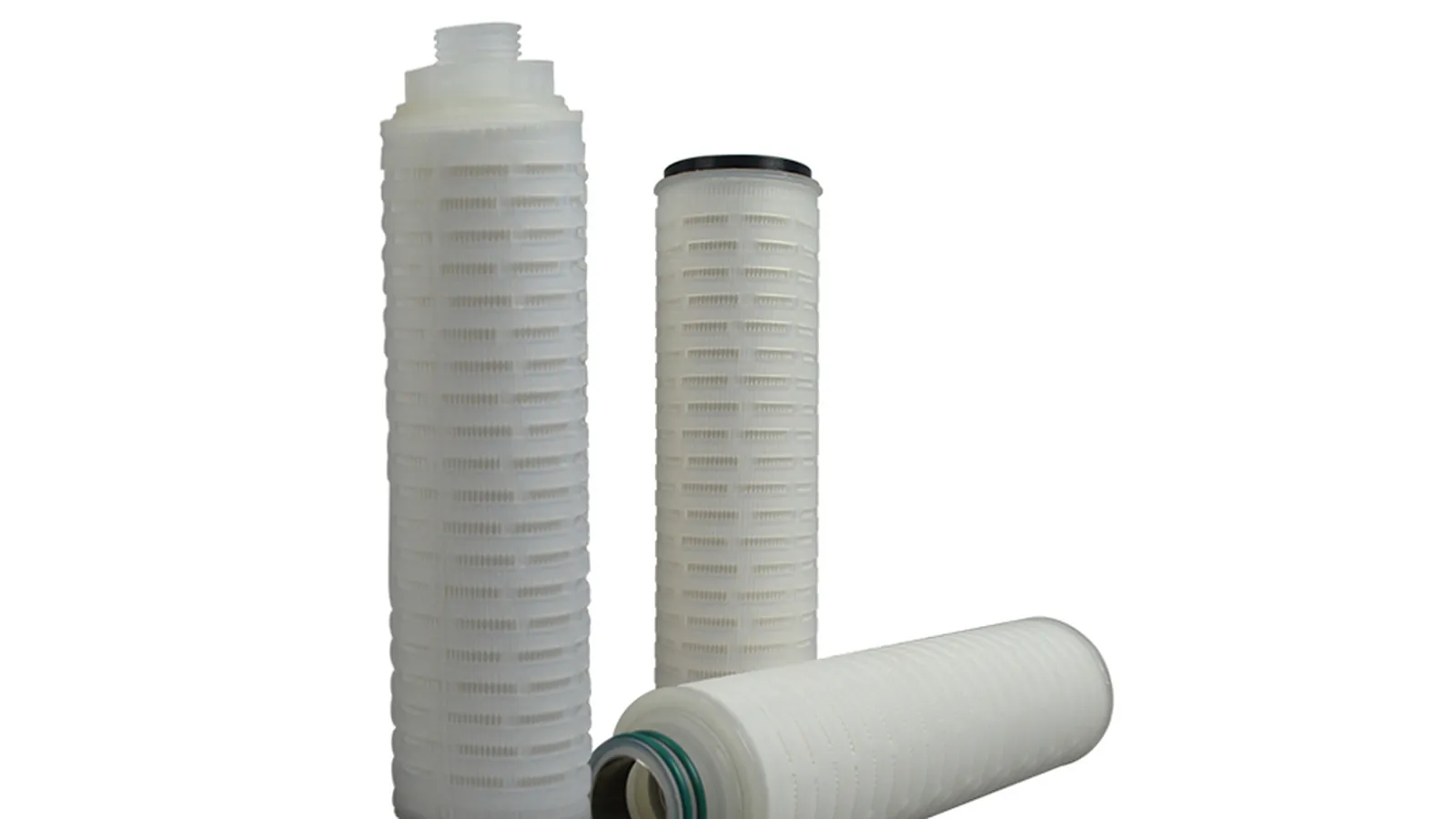
Table of Contents
A beverage plant in Lima replaced its sand filters with 20-inch pleated cartridges to "modernize" the line. Within a month the cartridge budget tripled: the raw well water carried a heavy silt load that the sand bed had absorbed for years at near-zero media cost. The cartridges blinded in days. The plant re-installed the sand filters and kept the cartridges downstream as final protection — where they belonged from the start.
Sand filters and cartridge filters are not competitors for the same job. They are different tools for different stages of the same train, and the mistake is treating them as interchangeable. This guide compares how each works, the numbers that matter (filtration degree, flow, backwash, cost per m³), when each is the right choice, and the hidden trade-offs that only show up in operating cost. It ends with a direct call for your application.
Key Facts at a Glance
- Filtration degree — Sand filters catch down to roughly 20–50 micron depending on media size and bed depth; cartridge filters reach 0.1–100 micron, with pleated polypropylene and melt-blown media far finer than sand.
- Operation — Sand filters clean themselves by backwashing (reverse flow through the bed); cartridge filters are disposable and replaced when pressure drop rises 10–15 psi.
- Flow — Sand filters handle high flow with low pressure drop; cartridge filters are flow-limited per housing and add pressure drop as they load.
- Cost profile — Sand: high first cost, low running cost. Cartridge: low first cost, recurring media cost. Break-even depends on your water quality and flow.
- Best role — Sand = bulk sediment removal on high-flow raw water. Cartridge = fine filtration, polishing, or protection of membranes and process equipment downstream.
How a Sand Filter Works
A sand filter is a pressure vessel filled with graded sand (or anthracite, garnet, or a multimedia mix). Raw water enters the top, passes down through the bed, and suspended solids are trapped in the voids between grains. The filtration happens in the top few centimetres of the bed — the "dirty layer" — while the rest of the bed holds the filter together hydraulically.
The defining feature is regeneration: when the bed loads up, you backwash. Water flows upward through the bed at a velocity that lifts and expands the sand, washing trapped solids out to drain. A typical backwash runs 10–20 minutes, uses 2–5% of the filtered volume, and restores the bed for another cycle. Media is replaced every 3–10 years depending on water quality — a long-life consumable, not a disposable one.
Practical limits: a single-media sand filter removes particles down to roughly 20–50 micron in practice (nominal, not absolute). Finer removal requires multimedia beds, slower flow, or coagulant dosing — which turns a simple filter into a treatment project. And because the bed stores dirt throughout its depth, a heavily loaded sand filter can release a slug of trapped material when flow surges, which is why downstream polishing exists.
How a Cartridge Filter Works
A cartridge filter is a disposable element inside a housing. Water passes from outside to inside through pleated or depth media, and particles are captured on the surface (pleated) or through the wall (depth). Ratings range from 100 micron coarse cartridges to 0.1 micron and finer for polishing and pre-RO duty.
The defining feature is precision: a cartridge removes exactly what its rating says, with a defined efficiency (nominal or absolute). A 5 µm pleated polypropylene cartridge removes particles at 5 µm with a known beta ratio — no bed-depth guesswork. The trade-off is that cartridges are consumables: replace them on pressure drop (typically 10–15 psi above clean) or on a schedule (3–6 months typical for water duty), and the media cost is recurring.
Cartridge systems are modular and scalable: add housings in parallel for more flow, or swap media grades for a different duty. No backwash, no media replacement, no operator attention beyond changing elements. For a plant that values simplicity and predictable effluent quality, that is a real advantage.
Direct Comparison Table
| Parameter | Sand filter | Cartridge filter |
|---|---|---|
| Filtration degree | 20–50 µm typical (nominal, coarse) | 0.1–100 µm (pleated, depth, melt-blown) |
| Filtration efficiency | Nominal; varies with bed state | Nominal or absolute; beta-ratio defined |
| Flow per unit | High; limited by vessel size and bed velocity | Moderate; add housings in parallel to scale |
| Pressure drop | Low and stable (0.1–0.5 bar typical) | Low when clean; rises as the element loads |
| Regeneration | Backwash, 10–20 min, 2–5% water loss | None — replace the element |
| Consumables | Sand media every 3–10 years | Cartridges every 3–6 months (typical) |
| First cost | High (vessel, media, piping, valves) | Low (housing + elements) |
| Running cost | Low per m³ (backwash water + occasional media) | Recurring media cost per m³ |
| Footprint | Large (vessel + backwash tank) | Small (skid or rack of housings) |
| Operator attention | Backwash cycles, media checks | Element changes on schedule/ΔP |
| Efficient quality | Coarse, variable with load | Fine, consistent and predictable |
When to Choose a Sand Filter
Choose sand when the load is high, the flow is high, and the target is coarse protection. Three situations in particular:
- Raw water with heavy silt — river, well or canal intake with turbidity spikes. A sand bed absorbs a load that would blind cartridges in days, at a fraction of the media cost per m³.
- High flow rates — municipal-scale or process-scale flows where cartridge banks would be enormous and element changes constant. Sand handles 10–50 m³/h per vessel without breaking a sweat.
- Pre-treatment before finer stages — sand as the first stage, protecting cartridge filters, carbon beds, membranes and ion exchange downstream. The sand stage does the dirty work; the fine stages do the precision work.
If you have one of these, sand is likely the right first-stage answer — but pair it with a fine stage, because sand alone will not give you the effluent quality a membrane or a process spec demands.
When to Choose a Cartridge Filter
Choose cartridge when precision, consistency or simplicity matters more than raw dirt-holding:
- Fine and consistent effluent — 5 µm or 1 µm protection for RO membranes, food and beverage process water, pharmaceutical and electronics water. Sand cannot deliver this; cartridges can, with a defined rating.
- Variable or low loads — closed loops, municipal water, cooling towers, where the load is light and cartridges run months between changes.
- Small footprint and quick deployment — packaged systems, skids, mobile units, where a sand vessel and backwash tank do not fit.
- No operator for backwash — cartridge systems are change-and-forget; sand systems need someone to run backwash cycles and watch bed condition.
If your spec calls for a defined micron rating with a documented efficiency, cartridge is not a preference — it is the only option that delivers it.
Hidden Trade-Offs Buyers Miss
Three costs hide until you operate the system:
1. Water loss. Backwash uses 2–5% of filtered volume. On a 100 m³/h system that is 2–5 m³ per backwash cycle, several times a day on dirty water. In a location where water or wastewater discharge is metered and costly, cartridge filtration — which loses only the water in the housing at change-out — can win on total water cost despite higher media spend.
2. Media cost crossover. The crossover point between sand and cartridge running costs depends on load. On light municipal water, cartridges at 5 µm may run 6 months and the media cost per m³ can be competitive with sand amortised. On heavy silt, the cartridge cost per m³ explodes — sand wins decisively. There is no universal answer; the load decides.
3. Slug release. A sand filter releases trapped solids during flow surges — a real risk for downstream membranes. Cartridges, loaded to spec, release nothing until they fail. If your process cannot tolerate a turbidity spike, put a cartridge final stage after any sand stage, no exceptions.
Hybrid Systems: Sand + Cartridge
The strongest configuration is not either/or — it is staged. A typical high-performance train: coarse strainer → sand filter (bulk solids) → 5 µm cartridge (polish) → 1 µm cartridge or membrane (precision). The sand stage removes the load cheaply; the cartridge stages protect what follows and deliver the spec. Each stage does what it does best, and the total cost per m³ is lower than either technology alone on demanding water.
For the cartridge stages, media choice matters: pleated polypropylene for low pressure drop and long runs, melt-blown depth for high dirt-holding, string-wound for coarse pre-stage duty, stainless mesh where cleanability is required. PLEATPURE supplies the full cartridge spectrum and can quote the fine stages of your train as one factory order.
The Final Call
Choose sand for bulk, high-flow, coarse removal on dirty raw water — and accept that it needs a fine stage downstream. Choose cartridge for precision, consistency, small footprint, or light loads — and accept the recurring media cost. On demanding water, stage them: sand for the load, cartridge for the spec. If you are not sure which stage your water needs, send us the water analysis and the flow rate — we will recommend the train, not just the filter.
NEXT STEP
Ready to Switch to Replacement Filter Cartridges?
Send us your element dimensions or part numbers — our team responds within 24 hours with pricing and lead time.
Written by
Ray ChanFiltration Buyer's Guide Author · Industrial Filter Cartridge Specialist. Ray helps global importers, distributors and maintenance teams source factory-direct replacement filter cartridges.